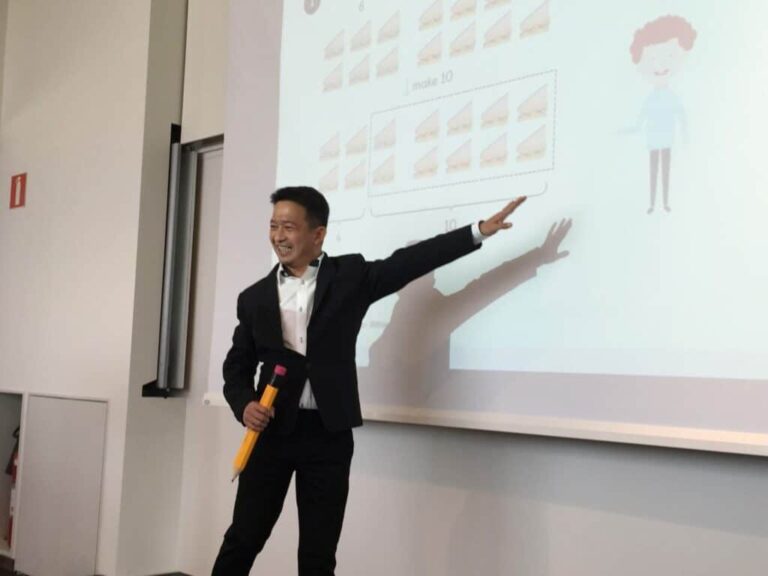
Dr. Yeap Ban Har, primary author of the think!Mathematics curriculum joined us to discuss the role of anchor tasks and board planning in student engagement. While he shared many valuable insights, below are three key ideas from the session…
Making Learning Stick: The Role of Anchor Tasks and Board Planning in Student Engagement
Mathematics is more than formulas and figures; it serves as a foundation for lifelong problem-solving and critical thinking. This was the focus of our latest roundtable, where renowned educator Dr. Yeap Ban Har guided teachers through what it truly takes to make learning “stick” in today’s classrooms.
Dr. Yeap explained that while clear explanations have their place, real understanding develops when students are given space to explore authentic, open-ended problems, which he calls anchor tasks. These hands-on activities spark curiosity, encourage collaboration, and help even the most reluctant learners build confidence with mathematical ideas. Drawing from research and international classroom experience, Dr. Yeap illustrated how this approach supports students in reaching and even surpassing grade-level expectations.
During the session, Dr. Yeap demonstrated how teachers can guide students to look beyond just finding answers. He modeled ways to encourage deeper questions, multiple strategies, and the use of evidence to back up thinking. He also emphasized the practical side of teaching, showing how strong classroom routines, structured discussions, and a spirit of teamwork make math learning meaningful and accessible to all.
A key takeaway was Dr. Yeap’s “three Cs”: concrete materials, conversation, and collaboration. These elements are not just educational jargon; they form the backbone of a classroom where students feel actively engaged and where learning lasts well beyond the lesson.
Whether you are a teacher seeking new inspiration or a parent hoping to support your child’s growth, Dr. Yeap’s roundtable offered practical strategies and a powerful reminder. Mathematical thinking is not just for school—it is a toolkit for navigating the challenges and opportunities of everyday life. If you are interested in seeing these ideas in action, watch the full discussion with Dr. Yeap Ban Har and discover how you can foster a deeper, more resilient mathematical mindset, no matter where your learning journey begins.