Figuring Out Fluency Beyond Facts and Algorithms
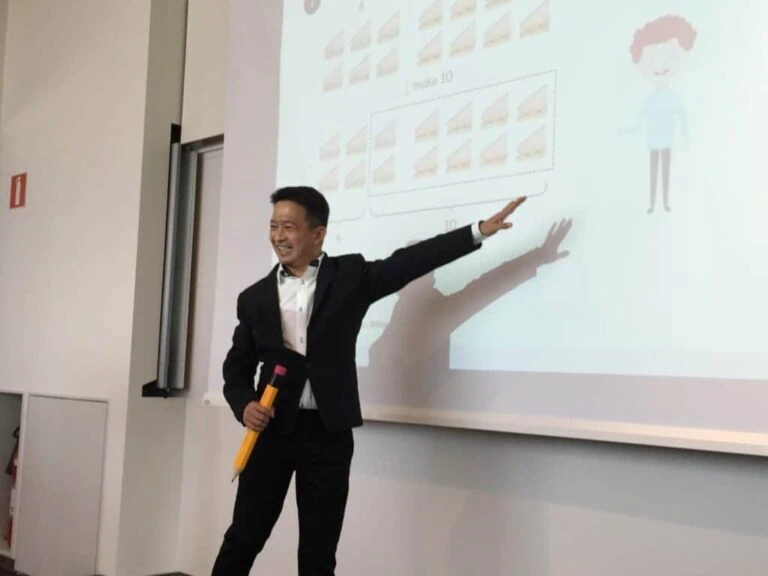
For our January 2026 Roundtable, we welcomed John Sangiovanni to lead a lively session on what it really means to be fluent in math—beyond memorizing facts or following rigid algorithms. John, a longtime educator and author, challenged participants to rethink the traditional view that fluency is just about speed or accuracy. Instead, he argued fluency is about flexibility, efficiency, and reasoning—skills that allow students to approach problems in ways that make sense to them, not just in the one way they’ve been taught.
Throughout the session, John shared stories and classroom examples showing how students naturally invent their own strategies for problems like 49 + 27, often arriving at creative solutions that weren’t explicitly taught. He reminded us that, for years, math education focused almost exclusively on the standard algorithm, but real mathematical thinking happens when students are invited to use alternative approaches, reason through estimation, and explain their choices. John modeled activities that encourage this sort of thinking, like predicting whether an answer is over or under a benchmark before calculating, and having students justify their reasoning to each other.
A big focus of the conversation was on the difference between strategies and representations—John clarified that tools like number lines or base-ten blocks are ways to show thinking, but the real strategies are the mental moves students make to break apart, combine, or manipulate numbers. He showed how a handful of powerful strategies can work for whole numbers, fractions, and decimals alike, and how important it is for students to learn when a strategy is efficient, not just how to use it. John also addressed common teacher concerns, like whether giving students multiple strategies will confuse them, and emphasized that all students—not just those who “get it”—deserve access to rich, flexible problem-solving.
As the session wrapped up, John connected these ideas to equity and student identity. He argued that true access in math means every student learns from a teacher who understands and values flexible thinking, and who helps them build the confidence and agency to make their own choices about how to solve problems. Developing this sort of mathematical identity, where students see themselves as capable, curious thinkers, is the ultimate goal of fluency work. John closed by encouraging educators to keep pushing these conversations forward, supporting each other, and making sure that every student’s way of thinking is seen and valued in the math classroom.